
Cable harnesses
Customized cable assemblies
Produced according to your requirements
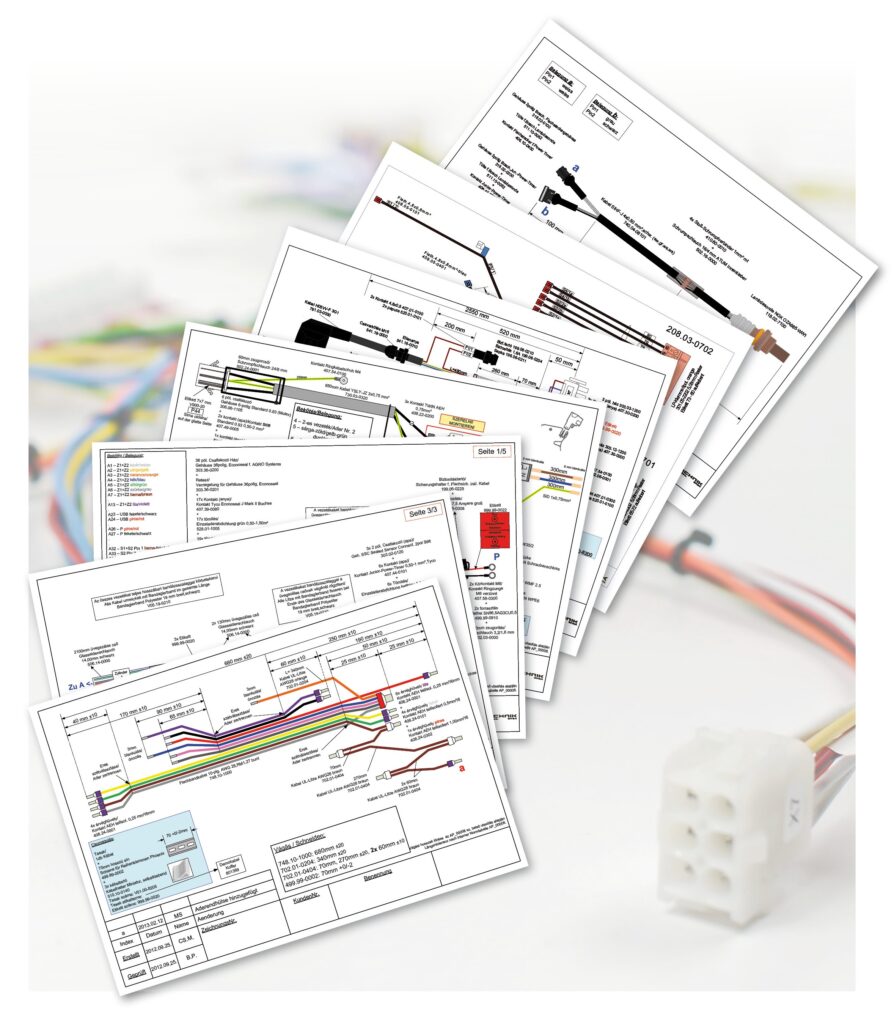
On the basis of samples, drawings and sketches, we develop precise production drawings for each individual solution. This data is made available to you free of charge and once the drawing has been approved, initial samples are produced to ensure smooth series production.
Production process
The following production process ensures flawless production:
- Drawing/sketch/pattern from the customer
- Creating a parts list and production drawing
- Release by the customer
- Production of a sample including initial sample test report
- Start of series production of cable assemblies
High quality standards
We work according to the highest quality criteria in all service areas. Our “PeMaC” plant in Hungary has both the ISO-Zertifizierung according to9001:2015as well as the Certificate of Compliance for the use of our cable harnesses in the international market.
The certifications with their defined criteria not only ensure the high quality of all products, but also help us to continuously improve our performance in all areas.
Manufacturing processes
From pre-assembled individual strands to complex cable harnesses, H&S Kabeltechnik GmbH develops and manufactures completely customized products according to your requirements. With our state-of-the-art production facilities, our own production drawings and an experienced team with many years of experience, we can respond to your wishes in the best possible way.
Cable cutting machines
Alpha 356
Gamma 255
over 300 crimping tools
3 Lumberg semi-automatic machines
Printing machines
Schäfer fully automatic machine with robot
Hotmelt Moulding
100% Traceability
FAQ: Cable assembly
H&S Kabeltechnik processes cable cross-sections ranging from AWG 32 or 0.04 mm² to 35 mm². The cable cross-section suitable for a specific cable assembly depends, amongst other things, on the cable type, the connector used and the technical requirements of the respective application.
Yes. H&S Kabeltechnik manufactures bespoke cable harnesses for industrial applications. The cable harnesses are assembled on specially made assembly boards and can be fitted with various components such as sensors, switches, fuse holders or capacitors. Bespoke drawings and parts lists are produced for each cable harness.
H&S Kabeltechnik produces prototypes before commencing series production. Once the technical documentation has been drawn up, a prototype, including an initial prototype test report, is produced and submitted to the customer for approval. Once approval has been granted, series production can start.
H&S Kabeltechnik processes a range of connectors and contacts in accordance with the requirements of the respective cable assembly. To this end, the company has at its disposal, amongst other things, more than 300 crimping tools as well as specialised equipment for cut-to-fit connectors. The connectors suitable for a specific project are determined on the basis of the technical requirements and the intended application. You can view some of these in our product overview.
H&S Kabeltechnik uses both fully automatic and semi-automatic crimping machines. These include, amongst other things, systems with crimp force monitoring, a tinning station and ferrule crimping. The quality of the crimp connections is checked, amongst other things, by measuring the pull-off force and by examining micrographs from the in-house laboratory.
Yes. H&S Kabeltechnik has printing machines that can be used to custom-print cables and heat-shrink tubing according to the customer’s requirements. This allows, for example, markings to be integrated for clear identification and further processing.
Yes. H&S uses the hot-melt process for low-pressure overmoulding. Thanks to the low processing pressure and comparatively low temperatures, this process is particularly suitable for sensitive components such as circuit boards or relays. H&S also has its own in-house capabilities for tool design for this process.
Quality is monitored throughout the entire manufacturing process. Before dispatch, every product undergoes an electrical test to detect, for example, short circuits, cable breaks or reversed polarity. In addition, depending on the manufacturing process, factors such as crimp forces, pull-out forces and cross-sections are checked, amongst other things.